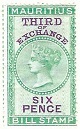
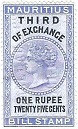
Impressed Duty Stamps
We now move away from the De La Rue printings, and
come to a more difficult area of identification for which scant
information exists. The only formal listing of Mauritius items under
this heading is contained in a book which I have previously mentioned
and produced by William A. Barber assisted by Norman Seidleman entitled
"The Impressed Duty Stamps of the British Colonial Empire". The latest
edition of this book, at the time of writing, is 2009.
How can one define an impressed duty stamp? It is usually in the form of
a non-adhesive stamp which has been created on a document by means of an
impressed metal die which shows an amount of money paid in duty to the
government of the country in which the document is executed. Embossed
adhesives were used in Great Britain and, suitably overprinted with the
country's name, used in some of the British Colonies. As far as I have
been able to ascertain, none were used in Mauritius. Many dies were (and
still are to a lesser degree) executed in blind embossing style known as
albino, which means that they are affixed directly onto the paper of the
document without any colour being used. Sometimes, albino embossing can
be difficult to read. Consequently, they were often combined with colour
to overcome this problem, thus then losing the albino description.
Embossing is actually created by using male and female moulds under
pressure, with paper being inserted between the two moulds: the paper
would then adopt the shape of the moulds, and would display a
multi-dimensional impression. Although this is usually called embossing,
as the image normally stands up from the paper, a system of debossing
also exists whereby the image is created below paper level.
Often, such dies are used to collect tax on court orders, and other
legal documents, alcohol and tobacco, and financial transactions. They
were first introduced in the United Kingdom as early as 1694 following
the Stamp Act of that year.
If an item was legally subject to duty or tax in law, and remained
unstamped, then it was unenforceable in a court of law. The rate of tax
could either be fixed as one penny (or later twopence) on a cheque, or
ad valorem in accordance to the value of the transaction
itself, such as the sale of an asset where this required legal
documentation.
Little detail exists as to when these items were introduced to
Mauritius, and the nearest start one can establish is that it was
probably shortly after the occupation by the British in 1810. I have
seen no evidence of Dutch or French embossings. The illustrations in
Barber's book all possess Sterling currency values, and the only way of
knowing when the stamp was used is if it has been preserved on the
original document - as in Plates
45 and
50.
Plate 89 shows two albino stamps, one with Sterling
currency and one with the later decimal values. these are copied from
originals, and the latter one does show a date. It is so faint that it
is quite difficult to read on the original stamp. On the copy it is
probably impossible to see. So many of these items were acquired on
original documents, being cut down to acceptable "stamp" size s othat
they would fit collectors' albums. Sadly this has effectively destroyed
a considerable amount of the detail of the island's commercial and legal
history.
The next two Plates
90 and
91 ,are rather interesting,
in that they record varieties, respectively, of the Sterling and Rupee
currencies. These are copied from the Barber book and, contrary to
virtually everything else I have displayed so far, have not been seen by
me in their original state. Here, they are shown as drawings of the
original impressions, but etched in black so that they can be easily
identified by a collector. They are not necessarily the only stamps
which were issued: there are, I believe, many more.
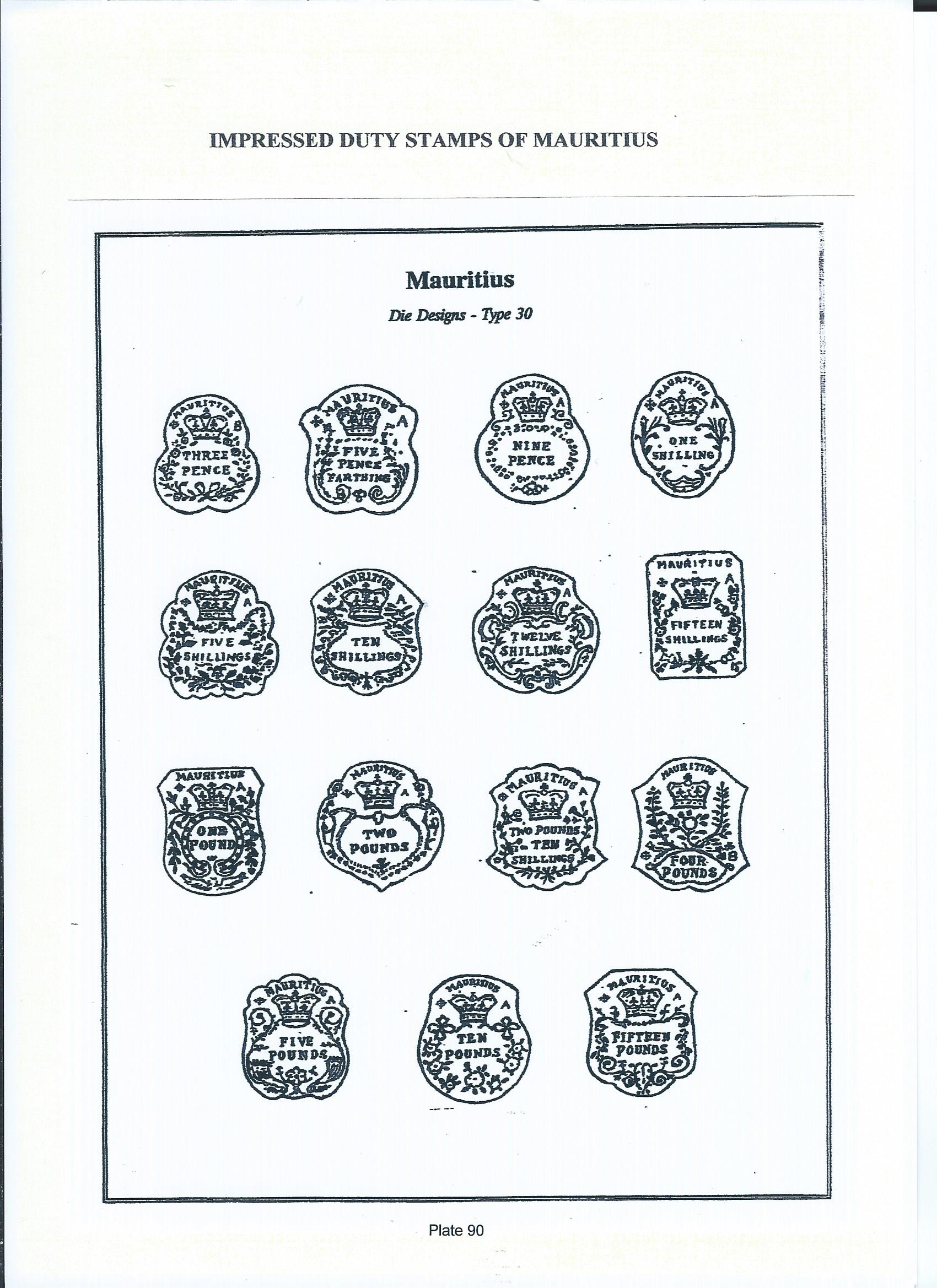
Plate 90 (click to
enlarge)
Later on, the dies became somewhat more sophisticated, if one reads the
letter dated 10 October 1973 on
Plate 92 from the
Ministry of Finance, Government of Mauritius, which indicates that
embossing dies were still in use. These dies included the facility for
changing the date and the amount. The letter states that there were
nineteen different values which could be shown and lists these from 5
cents to 10,000 Rupees.
I am attempting to obtain data from the Mauritius authorities about
subsequent activities, but at the time of writing I have not received
any further information.
The final illustrations relating to this section are on
Plate 93,
and show copies of extracts from a passport, originally dated 4 May
1963. This was before independence was declared on 12 March 1968 and,
therefore, the cover shows that it is a British passport accompanied by
the usual coat of arms. On the page containing the name of the bearer
there is a handstamp at the foot of the page which states" BRITISH
SUBJECT CITIZEN OFTHE UNITED KINGDOM AND COLONIES". Half way up is
printed "COLONY OF MAURITIUS".
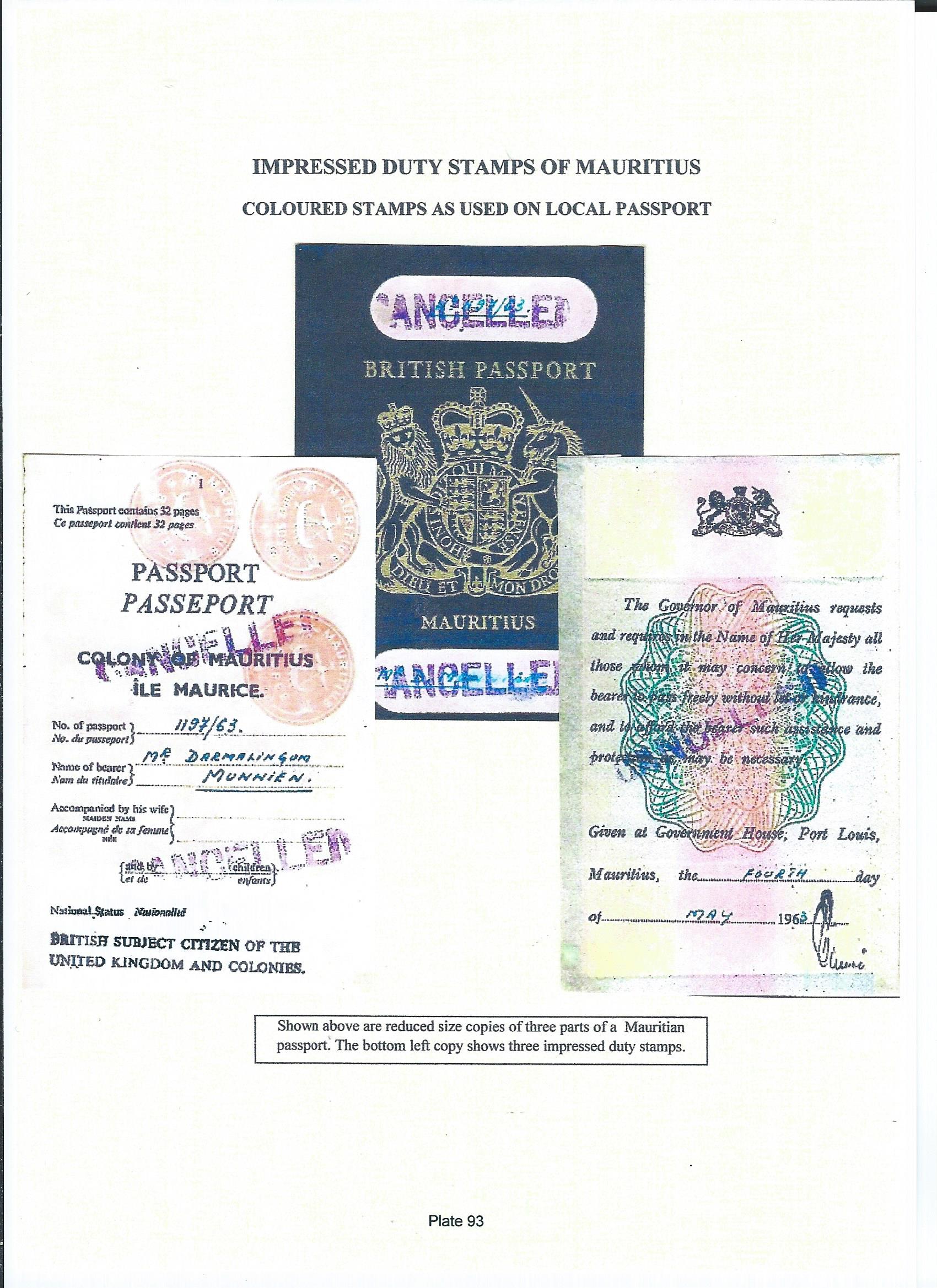
Plate 93 (click to
enlarge)
The three circular handstamps are, of course, the most relevant part of
the passport from the point of view of this book, which are impressed
across the bearer's name page. It will be noted that the flat part of
each impression is in red, and the embossed parts are in white, thus
making the whole impression much easier to read than those on the
earlier plates. Three separate values have been used i.e. one Rupee, one
Rupee fifty cents and five Rupees, thus making seven Rupees fifty cents
in total. It can be seen that variable dates have been used.